
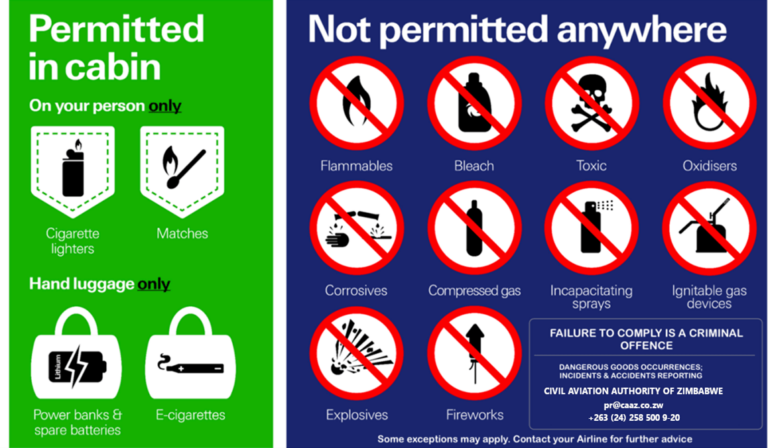
Transportation of Dangerous Goods by Air- Passenger Awareness System on Prohibited Items
Definition of Dangerous Goods
Articles or substances which are capable of posing a hazard to health, safety, property or the environment and which are shown in the list of dangerous goods in the ICAO Technical Instructions or which are classified according to those Instructions.
Limitations on the Transport of Dangerous Goods by Air
Some dangerous goods have been identified as being too dangerous to be carried on any aircraft under any circumstances; others are forbidden under normal circumstances but may be carried with specific approvals from the States concerned; some are restricted to carriage on all-cargo aircraft; most however, can be safely carried on passenger aircraft as well, provided certain requirements are met.
Functions and Services
The Flight Operations Department provide dangerous goods technical expertise to the aviation industry and their key responsibilities include the regulatory oversight in terms of the orderly and safe transportation of dangerous goods by air and the regulatory oversight of the aviation industry to ensure the safe, secure and orderly transport of dangerous goods by air.
Dangerous Goods Training
The Zimbabwean Civil Aviation (Dangerous Goods) Regulations, SI 51 of 2018 requires the persons involved in commercial air transport operation (passengers, cargo or both) to receive initial and recurrent training within 24 months of the initial training in dangerous goods.
All training must be in accordance with the Regulations or the provisions as detailed in the ICAO Technical Instructions.
Dangerous Goods Training Organizations
Only training organizations that are approved by the Director General of the Civil Aviation Authority of Zimbabwe may provide dangerous goods training in accordance with the national regulations.
Dangerous Goods Accident and Incident Reporting
The operator of an aircraft, cargo warehouse personnel, aerodrome manager, ramp and ground handlers involved in a dangerous goods accident or dangerous goods incident within the Republic of Zimbabwe, shall within 48 hours after such accident or incident has occurred, notify the Director General of such an occurrence.
The operator of a Zimbabwean aircraft involved in a dangerous goods accident or dangerous goods incident outside the Republic, must, as soon as practicable, notify the appropriate authority of the State in territory where the accident or incident has occurred and the Director General CAAZ, of such accident or incident.
Notification of Undeclared or Mis-declared Dangerous Goods
The operator of an aircraft in which dangerous goods are conveyed within the Republic of Zimbabwe or outside the Republic of Zimbabwe shall, within 48 hours after the discovery of any undeclared or mis-declared dangerous goods; or dangerous goods not permitted on board the aircraft or in the baggage of a passenger or flight crew member, notify the Director General or the appropriate authority thereof, as the case may be.
In order to prevent the occurrence of instances of undeclared and mis-declared dangerous goods in cargo each operator shall establish procedures for investigating and compiling information concerning such occurrences in the territory and which involve the transport of dangerous goods originating in, or destined for, another territory, and those procedures must be clearly stated in the Operations Manual (OM).
Dangerous Goods Enforcement
Where necessary, Dangerous Goods Inspectors may follow enforcement procedures with a view to enforcing compliance.
Granting of Exemptions and Approvals
The Director General may grant an exemption to enable the transport by air of dangerous goods which may not be permitted in normal circumstances or in conditions which are different to those prescribed in the regulations. Further guidance and appropriate application forms available on the CAAZ Flight Safety and Standards department.
- Issuance of Air Operator Certificates(AOC)for local operations
- Issuance of Air Operator Permits (FOP) for foreign Airlines
- Oversight of the activities of AOC and FOP holders.
- Approval of Dangerous Goods Handlers and Shippers.
- Develop and implement Fatigue Risk Managements Systems
- Development of guidance material for the aviation industry.
